Liability and Maintenance Issues for Greenway Trails
Tina Berglund, Mary Macpherson , and Leah Schinasi
Environment and Land Use Planning Seminar, Vassar College
April 29, 2003
Uncertainty about landowner liability can be a significant obstacle to developing greenways. The purpose of this paper is to explain that liability is not a major issue of concern for private property owners who open their land for use as a public recreational area, using Vassar College, a large, privately-owned institution, as a case example. Also, we will discuss maintenance issues as they relate to liability and explain our finding that private property owners are not responsible for managing any land that they have opened for public access nor are they liable for injuries that trail users experience due to poor maintenance of the greenway.
This paper will discuss the following topics:
· Introduction
· Why there is so little written about liability issues for greenway planning
· A description of Vassar College’s boat house property, which we use as a case study here
· Liability
o A description of the New York State General Obligations Law (NYS GOL) 9-103 and the way that this law provides protection against liability to private landowners
o Court cases that tested NYS GOL 9-103
o Types of insurance that protect landowners against liability
· Maintenance, which is a secondary concern for landowners
o Types of maintenance activities necessary on a greenway
o Suggestions for organizing a maintenance plan
o Financing maintenance
o The group responsible for maintenance activities
o Vassar College’s position on maintenance
· The connection between liability and maintenance and an explanation of why landowners are not liable for injuries that result from negligent maintenance of the portion of the greenway that crosses their property
· Conclusion
Introduction
Greenways provide space for human recreation and protect valuable natural resources. They are therefore beneficial and desirable in most communities. However, it is difficult to construct these trails, which stretch throughout various sections of a community, on only publicly owned property. For this reason, a major difficulty that greenway planners must overcome is convincing private property owners to allow the trail to cross their property. This obstacle results from the many concerns that individuals have over opening their property for public use. One major worry that individuals express is that they will be liable for injuries that trail users suffer while crossing their property. Also related to the liability concern is the question of maintenance and who will perform the tasks necessary to ensure that the trail is safe for the public. Therefore, an understanding of the protection that is available to private property owners is integral to greenway planning.
There is a very small amount of existing literature that describes private property owners’ various protections against liability. This lack of discussion may be due to the fact that liability protection varies depending upon the state in which the greenway is located. In addition, the findings of the research for this paper suggest that the lack of literature on private landowner protection against liability results from there being little to say on this issue. Liability is not a great concern because of the protection that state recreational laws and, optionally, additional insurance policies provide. However, these protections are unknown to many individuals, and uncertainty about landowner liability thus remains a significant obstacle to developing greenways. The purpose of this paper is to explain that liability is not a major issue of concern for private property owners who open their land for use as a public recreational area. We use Vassar College, a large, privately-owned institution, as a case example. Also, we will discuss maintenance issues as they relate to liability and explain our finding that private property owners are not responsible for managing any land that they have opened for public access nor are they liable for injuries that trail users experience due to poor maintenance of the greenway.
As a case study for this report, we will look at Vassar College’s waterfront boathouse property. This property lies between Marist College’s boathouse property, which is in the process of being turned into a public park, and the Dutton Lumber site, currently owned by the Myron family of Poughkeepsie (Figure 1a). Scenic Hudson is presently in negotiations to buy this property from the family and would open it to the public, allowing a trail to run from Marist’s property through Vassar’s property, behind the boathouse, and through the former lumber site into Waryas public park. (Figure 1b). The main concerns that Vassar College has about opening its waterfront property to the public are liability and maintenance (B. Eismeier, pers. comm., J. Horst, pers. comm.).
Liability
As in the case of Vassar College, when private landowners consider allowing public access to their property, they commonly have concerns about liability, vandalism and maintenance, amongst other things. However, according to the Greenway Conservancy for the Hudson River Valley and the New York Parks and Conservation Association, these issues are more perceived than they are actual problems (Dropkin, 2002). We will attempt to show in this section of the report that, although liability concerns are understandable, there is extensive coverage provided by several sources.
New York General Obligations Law 9-103
The New York State General Obligations Law is the first and most important source of liability protection available to landowners. The State Legislature originally introduced the law in 1956 as part of the Conservation Law, covering only hunting, fishing, trapping and training dogs. The Legislature later amended and transferred the law to the General Obligations Law, at which time the number of recreational activities to which it applied was expanded to what it covers today (Bragg v. Genessee County Agricultural Society). According to the law, landowners are not liable when allowing public recreational access to their land unless they are charging a fee or the conditions of the property are extremely hazardous. The law says,
An owner, lesee or occupant of premises, whether or not posted as provided in section 11-2111 of the environmental conservation law, owes no duty to keep the premises safe for entry or use by other for hunting, fishing…organized gleaning…canoeing, boating, trapping, hiking, cross-country skiing, bicycle riding, hand gliding, motorized vehicle operation for recreational purposes, snowmobile operation, cutting or gathering of wood for non-commercial purposes or training of dogs… (NYS 9-103).
Landowners who allow access to
their property for these recreational purposes do not, according to the law, assure
to the user that the property is safe or take responsibility for any injury
that the person suffers. They are thus exempt from liability for any
occurrences of injury on their property
(NYS 9-103). In 1994, this law
was challenged but the New York State Court of Appeals ruled in favor of the
landowner, stating that, “the premise underlying Section 9-103 is simple
enough: Outdoor recreation is good; more places will be made available if
property owners do not have to worry about liability when recreationists come
onto their land…the statute implicitly contemplates a tradeoff for the public
use; recreationists, if permitted to use the lands of others, must assume the
risks of doing so” (Bragg v. Genessee County Agricultural Society). Thus, the
New York State General Obligations Law, section 9-103, provides, in a way, an
umbrella cover for landowners. There are also several additional methods of
coverage against liability, which will be discussed later.
Court Cases Testing the Law
The strength of liability protection can be seen in the fact that the New York-New Jersey Trail Conference and the Finger Lakes Conference, together managing more than 1700 miles of trail, have never experienced a trail-related lawsuit (Greenway Conservancy for the Hudson Valley, 1996). However, a limited number of lawsuits have tested the New York State General Obligations Law 9-103. One example case is Theresa Albright v. Harlen W. Metz, Jr. (1996), which was a lawsuit concerning an injury incurred while motorbiking at a former mine and current landfill. The plaintiff’s son had been injured while he fell thirty-five feet from a gravel cliff when riding his bike at the landfill property. The focus of this lawsuit was on whether or not the property was suitable for recreational use, and based on previous recreational use without injury, the court determined that it was suitable. The court stated,
Based upon the undisputed evidence of the past public recreational use of the Metz landfill to ride dirt bikes and other motorized vehicles to demonstrate the suitability of the property for such use, and in the absence of any evidence to demonstrate that the landfill operation actually detracted from the property’s suitability for recreational purposes, we conclude that the property is suitable for the recreational use in which plaintiff’s son was engaged when he was injured (Theresa Albright v. Harlen Metz, Jr.).
The plaintiff then filed motions to examine the suitability of the property based on its general characteristics and physical attributes rather than past recreational use. This motion was also passed in favor of the defendant, as were additional motions filed by the plaintiff. The court determined that the correct way to determine the suitability of the property was in fact to study how recreationists had used the property in the past. The court also determined that, under the statute in the General Obligations Law, property owners are not required to keep their premises safe for recreationists. This case serves as a model for other landowners, showing that the individual landowner is not responsible for keeping his or her property safe for recreationists, as long as the land is generally suitable for the determined recreational purpose.
In another case in 1994, the plaintiff, Ronald Bragg, was injured while driving his motorbike into a ten-foot hole created by excavations of gravel at an abandoned railway bed. In this case, the plaintiff needed to present evidence that the defendants had acted willfully and maliciously in not posting warning signs. If this were the case, the defendants would not be covered under the New York General Obligations Law 9-103. The plaintiff also argued that, while the property had been suitable for recreation a few months earlier, it was no longer so because of the excavations. The defendants maintained that the statute in the law still protected them against liability because the property was suitable for recreation by its general characteristics, and that it should not be judged by alterations made at a specific time. According to the court, “The statute removes any obligation on the landowner ‘to keep the premises safe…[and] to give warning of any hazardous condition…to persons entering for [recreational purposes]’. If this language is to have any force, suitability must be judged by viewing the property as it generally exists, not portions of it at some given time” (Bragg v. Genessee County Agricultural Society). The court also decided that there was no evidence of malicious intent by the defendant in not posting warning signs, and therefore, dismissed the case. This case shows the power and ability of the New York General Obligations Law 9-103 to protect landowners against liability.
Insurance Coverage
In addition to the liability coverage that the New York General Obligations Law 9-103 offers, the Hudson River Valley Greenway Conservancy has also purchased an additional commercial insurance policy, available to property owners who allow a greenway trail to run through their land. Corporate or institutional landowners, such as Vassar College, are expected to cross-insure the Greenway Conservancy as an “additional insured” on their already existing policies. The additional package offered is a standard commercial policy underwritten by Chubb, covering up to $6 million for individual occurrences and a $7 million annual aggregate. Coverage is only available for trail access agreements, not for easements made strictly for conservation. The policy is also limited to trails that do not allow motorized uses (Kovalchik, pers. comm.).
Over and above the
protection provided by the New York State General Obligations Law 9-103 and the
insurance policy purchased by the Hudson Valley Greenway Conservancy, Vassar
College protects itself through an institutional insurance policy. According to
Betsy Eismeier, Vice President of Finances at Vassar College, this is an
umbrella policy that covers the main campus and all non-adjacent property used
for purposes connected to education.
One of the college’s main concerns about liability is security. On the main campus, security officers and members of the Student Patrol group monitor the campus twenty-four hours a day, but at the waterfront property, security is very limited. Presently, there is a locked gate that restricts public access to the property on all occasions except during crew team practices and meets. From conversations with Ms. Eismeier, it seems that Vassar’s main concern with liability is security and having eyes, at all times, on the site that it is open to the public. Thus, in order to fully participate in the greenway, Vassar College would like to see united security for the Marist College park and the Vassar property, as well as the Dutton Lumber site, if it should be bought by Scenic Hudson. One option suggested by Eismeier is to have Marist hire additional security guards, with Vassar splitting the cost, or to contract out for private security just for the waterfront properties.
Maintenance
A second point of consideration in the discussion of property owner liability is trail maintenance. A good maintenance program is essential to the preservation of a greenway, not only for aesthetic reasons but also for the purpose of ensuring trail users’ safety (Flink and Searns, 1993). Many private property owners acknowledge this need and express concern over who will provide the time, money, and energy necessary to undergo the required maintenance tasks. This is an important consideration. We will discuss the various management activities that are necessary on greenway trails and suggest methods for meeting these goals. At the same time, we will explain the findings of our research that private landowners are not liable for injuries that trail users incur on their property because owners are not responsible for managing the portion of the trail that crosses their land.
Flink and Searns (1993) explain that there are two categories of maintenance activities. First, routine maintenance describes daily activities such as weeding, trimming, cleaning, and trash collection, as well as minor repairs and replacements, like fixing a broken fence. Also, in order to protect against danger on a trail, it is necessary to keep safety railings, pedestrian bridges, and warning signs in good condition. The second category is remedial maintenance, which describes activity necessary to restore major components of the trail that have been destroyed or damaged, or correct any landscape problems. For example, it might be necessary to stabilize an eroded hillside or replace a bridge that has been destroyed due to poor weather conditions (Flink and Searns, 1993).
Suggestions for Organizing a Maintenance Plan
A good greenway maintenance plan and schedule help to ensure good trail management. Developing a checklist that records all maintenance functions, problems, and locations is helpful for this purpose. The maintenance schedule should include such items as a list of specific maintenance activities, frequency of each activity, cost per application, annual cost of the performance, and who will pay for and perform each activity (Flink and Searns, 1993). Several trail maintenance guides exist on the internet for trail planners’ easy reference (Appendix 1, Bachensky, 2003, California State Parks and Recreation, 2003, Iowa Department of Transportation, 1998). Also, the Denver Bicycle Master Plan posts an example of a maintenance checklist on the American Trails website. This includes a list of maintenance activities that are performed on a continuous scheduled basis, as well as one that describes tasks that they perform irregularly and only when necessary (Wagner, 2003).
Not only does the Denver directory list general cleaning and repair activities, but it also includes such tasks as the creation of good maps for trail users, the provision of educational tours, proper training of employees, creating public awareness of the trail, and volunteer coordination (Wagner, 2003). Flink and Searns (1993) add that a good maintenance program should include a public monitoring program that allows citizens to report maintenance problems, as well as a manual that describes the appropriate procedures for maintenance performance.
Financing the Maintenance Activities
Maintaining greenways is expensive (Flink and Searns, 1993, North Carolina State University Libraries' Special Collections Department, 2001) and requires adequate financial support. However, in the Hudson Valley, the municipality or greenway conservancy, not the private property owner, is responsible for paying for the maintenance activities (Kovalchik, per. comm., Greenway Conservancy for the Hudson Valley, 1996). Organizations responsible for maintenance may receive funding from a variety of sources. First, several trail projects have utilized creative fundraising activities to raise money. For example, a Dutchess county dairy supports the Appalachian Trail by sale of its “Appalachian Trail Mix Ice Cream.” They donate a percentage of the proceeds to trail groups that maintain the Appalachian Trail. Several other groups have held raffles and sold items such as t-shirts, buttons, cookbooks to raise money. Also, a number of organizations and foundations exist within the Hudson River Valley who offer money for trail projects. Examples of these organizations are the Greenway Conservancy Grants Program and the National Recreational Trails Program. Larger, more comprehensive lists of organizations from which funds may be obtained appear on the internet: (Hudson Valley Greenway Conservancy, 2000).
The group responsible for maintenance
In the Hudson Valley, the Hudson River Valley Greenway Conservancy (HRVG) does not own or maintain any of the trails. This is because HRVG, as a state entity, cannot obtain land from the community. Usually, greenway management occurs through partnerships between landowners, private volunteers that are associated with a trails organization, and local and regional governments (Dropkin, 2002). Many organizations in the Hudson Valley help with trail maintenance, such as the New York New Jersey Trail Conference and the Student Conservation Association, as well many Public Works Departments at the county or town level (Kovalchik, pers. comm., 2003). HRVG does not require that a landowner maintain the portion of a trail that appears on his or her property. However, landowners do have the opportunity to actively participate in management plans and help make decisions that will affect their property (Kovalchik, pers. comm., 2003, Greenway Conservancy for the Hudson Valley, 1996).
Maintenance of most trails occurs by volunteer activity. For example, the Kennebec River Rail Trail, a non-profit group that consists of local volunteers, maintains a recreational trail between Augusta and Hallowell, Maine (Bicycle Coalition of Maine, 2003). Furthermore, more than 85 hiking clubs and environmental organizations and 10,000 individuals involve themselves in the New York-New Jersey Trail Conference, through which they work to build and maintain marked hiking trails. Volunteers also work to maintain trails in Nelsonville and Sleepy Hollow, NY (Dropkin, 2002).
Vassar College’s Position on Maintenance
In its consideration of opening its land for public use in the Hudson River Valley Greenway, Vassar College has discussed maintenance issues. While the college recognizes the need for signs that warn of dangers and is willing to post these, it does request help with other maintenance activities. As mentioned earlier, Vassar hopes that there will be a cooperative agreement between itself and the owners of adjoining pieces of property, Marist College and the Dutton Lumber yard, in the performance of security patrols. Meanwhile, Vassar assumes that the greenway will be developed as an extension of the pre-existing, publicly owned road that runs near the property (Figure 1b). Therefore, the college expects that the city of Poughkeepsie will organize maintenance tasks, such as grounds clean-up, on the greenway (Eismeier, pers. comm.).
The Connection Between Liability and Maintenance
The connection between liability and maintenance concerns lies in that the New York General Obligations Law 9-103 requires that property to which the public has access be suitable for its recreational purpose. However, private landowners have no reason to worry about maintenance activities as they relate to liability. This is because the NYS GOL 9-103 protects landowners from liability for not having performed routine maintenance activities, as long as this failure was not a willful or malicious attempt to create dangerous conditions on the property. However, when a municipality approves an area for public access for a recreational activity, it assumes a duty to maintain the safety of that area. Therefore, NYS GOL 9-103 does not protect a municipality who fails to fulfill its duty of reasonable care in maintaining a public recreational area (Patrick Sena v. Town of Greenfield).
The reason that the NYS GOL 9-103 law provides protection to private landowners but not to municipalities lies in the origin of the law. The purpose of the NYS GOL 9-103 is to encourage private landowners to allow public access to their property. However, municipalities are motivated to create public recreational areas because they serve the general public. Therefore, municipalities do not require the incentive of immunity against liability to establish public areas (Patrick Sena v. Town of Greenfield). Crombie (2000) writes about the link between liability issues and maintenance regarding waterfront trails in Canada and says that municipalities have a responsibility to manage their trails in order to ensure the safety of trail-users. Landowners who allow access to their property do not hold this responsibility and will not be held liable for their failure to do so.
Conclusion
As evidenced by the coverage provided by New York State General Obligations Law 9-103, the additional insurance policy purchased by the Hudson Valley Greenway Conservancy, and Vassar College’s own insurance policy, liability should not be a major concern for private landowners considering allowing public access to their land. As we have discussed earlier in the report, another potential concern related to liability is maintenance of the greenway. However, the NYS GOL 9-103 states that the property only needs to be generally suitable for the designated recreational purpose and that the owner is not responsible for keeping the premises safe. Furthermore, the municipality, not the landowner, is liable for any injuries that trail users experience due to failure to maintain the greenway. As a result of the findings of this study, we hope that more private property owners will consider opening their land to the public and be aware that liability does not need to be a major concern. We hope that the information provided here will fill the gap in the literature on greenways that fails to mention liability issues. While there is not a major reason for landowners to concern themselves with liability issues, the fact remains that education on the subject is necessary for public cooperation in greenway planning and implementation. As a final statement, we do want to make clear that the report was written by a group of college students without any direct legal background. However, we have researched all of the available sources, all of which provided consistent information. For confirmation on the matter, we recommend reading the sources that we mention in this report and perhaps consulting with a lawyer.
References
Bachensky, L. (2003) Maintenance management systems for trails. U. S. Forest Service, Rocky Mountain Region. http://www.americantrails.org/resources/ManageMaintain/BuildMaintSys.html.
Bicycle Coalition of Maine. 2003. Kennebec River Rail Trail. http://www.bikemaine.org/krrt2.htm.
California State Parks and Recreation. (2003) Trail shorts: A cursory look at trail maintenance.
http://www.foothill.net/fta/work/maintnotes.html
Crombie, D. (1995) The waterfront trail: Liability and risk management issues. Waterfront regeneration trust. Toronto, McCarthy Tetrault.
Dropkin, R. (2002) Getting involved: A community trail handbook for landowners. New York
Parks and Conservation Association and Greenway Conservancy for the Hudson River Valley, Albany.
Flink, C. A. and Searns, R. M. 1993. Greenways: A guide to planning, design, and development. Island Press, Washington D. C.
Greenway Conservancy for the Hudson River Valley, Inc. (1996) Hudson River Valley
Greenway Trails: Getting started-a guide to organizing and planning. Albany.
Hudson Valley Greenway Conservancy. (2000) Funding for Trail-Related Projects. traihttp://www.hudsongreenway.state.ny.us/conserv/Trail%20Funding%20Guide.pdf
Moore, R.L., Graefe, A. R., Gitelson, R. J., and Porter, E. (1992) “The impacts of rail-trails:A study of the users and property owners from three trails.” National Park Service, Washington D. C.
New York General Obligations Law, section 9-103, 1956.
North Carolina State University Libraries’ Special Collections Department. (2001) Survey Data.
http://www.lib.ncsu.edu/archives/greenways/survey.html.
Patrick Sena v. Town of Greenfield, 91 N.Y.2d 611, 696 N.E.2d 996,673 N. Y.A.2d 984 (NY
Int. 1998).
Ronald Bragg v. Genesee County Agricultural Society 84 N.Y.2d 544, 644 N.E. 2d 1013, 620 NY..2d 322 (NY Int. 1994).
Thagard, S. (1996) “Rail-trail Maintenance: Preparing for the Future of your Trail.” Rails to
Trails Conservancy. http://www.trailsandgreenways.org.
Theresa Albright v. Harlen W. Metz, Jr. 88 N.Y.2d 656, 672 N.E.2d 584, 649 N.Y.S.2d 359 (NY
Int. 1996).
Wagner, J. (2003) Maintenance checklist for urban trails. Denver Parks and Recreation
Department. http://www.AmericanTrails.org.
Appendix 1. This is an example of a maintenance guide for trails and greenways. Additional information on the subject can be found in the other mentioned sources on the internet.
This
document is reproduced with permission from
California State Parks and Recreation
http://www.foothill.net/fta/work/maintnotes.html
 TRAIL
SHORTS
TRAIL
SHORTS
A Cursory Look at Trail Maintenance
INTRODUCTION
This document focuses on wilderness trails only and is intended to be used as a reference by trail maintenance crews. If you have questions about the contents, please do not hesitate to contact Clay Phillips at the Southern Service Center of California State Parks at (619) 220-5303.
Trail
construction and maintenance is an inexact science with many variables. Much
depends on the location of the trail, the soil, the climate, and the types of
uses. However, there are certain general guidelines which, if adhered to, will
prevent most trail deterioration and minimize maintenance costs.
Trail Problems
Trail users may not be able to articulate what a "perfect" trail looks like, but almost everyone can list the characteristics of a "bad" trail:
- Deep Trenching - The trail is sunken such that hikers feel like they're walking in the bottom half of a pipe and equestrians drag their spurs.
- Widening - The trail has widened from a single or double track to an unsightly wilderness "freeway" of multiple parallel tracks, all trenched to a different degree.
- Short Cuts - Knowing that the shortest distance between two points is a straight line, users create a web of trails, most of which are steep and erosive.
- Tripping Hazards - Regular use and erosion ultimately expose tree roots and rocks.
- Steepness - If a trail is too steep over a long distance one of two things will happen: either people won't use it, or users will not enjoy their excursion.
- Impact to Natural / Cultural Resources - Erosive trails and multiple trails compound the impact that trails have on rare plants and on archaeological sites.
Causes
All of these problems can be tied to one or more of the following three causes:
- Water is the foremost cause of trail problems. The movement of water causes erosion and deep trenches. It also exposes tripping hazards.
- Poor Initial Trail Design can rarely be overcome, even by regular maintenance.
- Inadequate or Inappropriate Maintenance wastes valuable crew time and can sometimes increase trail problems.
DESIGNING FOR TRAIL MAINTENANCE
Ultimately, the most influential component of trail maintenance is the original trail design / alignment. A well-designed trail will be easier to maintain, will deteriorate more slowly and will be more pleasant to use. On the other hand, a poorly-designed trail is difficult to maintain, deteriorates quickly and, once you lose it, there's not much that can be done to restore it. In addition, a poorly designed trail will always be less pleasant to hike or ride.
Elements of a Well-Designed
Trail
There are many factors which go into a well designed trail; here we will only look at the elements required from a maintenance perspective.
- Gradient
Generally, the linear gradient of a trail should be less than 10%. The term "gradient" refers to the ratio of the rise over the run. In other words, an elevation gain of 2 feet in 20 horizontal feet represents a 10% gradient.
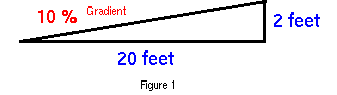
Ten percent is a good standard, but circumstance may warrant a greater or lesser gradient.
In
highly erosive, sandy soils, a 5% slope may be excessive. Granitic soils are
more forgiving and can allow long sections of trail to be constructed at 13 to
15%. It is best to look at existing trail conditions and measure gradients to
determine what maximum gradient works best in each unique condition. However,
it should be noted that trails less than 10% are far more comfortable to hike
and ride. The soils may allow for a trail that exceeds 10%, but the users might
not!
- Relationship to Existing Contours
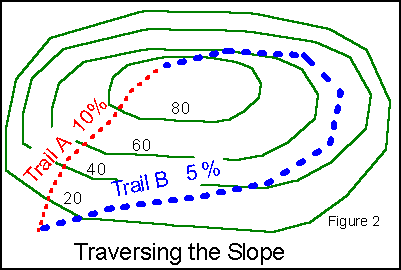
In map jargon, a contour is a line of points that are at the same elevation. If you walk precisely parallel to a contour, you are walking at a level (0%) grade. If you walk perpendicular to a contour, you are walking either straight uphill or straight downhill. A well-designed trail is laid out to traverse a hillside, closer to parallel than perpendicular to the contours.
The
figure below shows two proposed trail routes to the top of the hill. Although
Trail A stays within a gradient of 10%, it is the poorer route because it
travels perpendicular to the contours. When a trail runs perpendicular to the
contours, water runs down the middle of the trail, causing trenching, even at a
10% gradient. The only way to get water off the trail is for the route to traverse the natural slope (Trail B),
because then there is always a lower side of the trail. When there is a lower
side of the trail, it becomes a simple matter to redirect water across and off
the trail, rather than allowing it to cut a channel down the trail's
centerline.
- Outslope
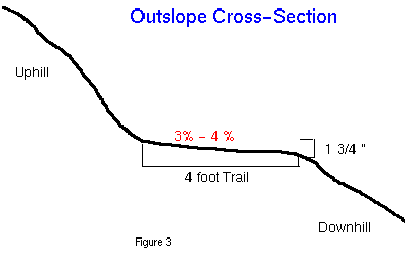
A well-designed trail should be constructed to have a 3% to 4% cross-slope to get the water off the trail as soon as possible. This explains why it is difficult to construct an effective trail in a flat meadow. You can not merely cut out sod and call it a finished trail. It will always be easiest to construct an outsloped trail if the original trail alignment traverses the natural slope as in Trail B, above.
- Avoid Switchbacks
A "switchback" is any place where the alignment of a trail traverses a slope in one direction and then abruptly "switches back" toward the opposite direction. Switchbacks are often used to run a trail up a steep slope in a constrained location. Although switchbacks are often the only solution to the problems of rock outcrops and steep slopes, they should be avoided where possible. Unless they are perfectly designed and constructed, switchbacks present an irresistable temptation to shortcut the trail and cause erosion over a web of indescriminantly created volunteer routes.
KEY ELEMENTS OF TRAIL MAINTENANCE
The first step of trail maintenance is to inspect the trail. When erosion problems are evident, the principle questions to ask are, "Where is the water going and how can I get it off?"
The
following elements represent the primary "tools" to be used in the
maintenance of trails. They are generally listed in priority order, but each
has its own special application and purpose. Clearly, though, the first 3
(Maintaining the Outslope, Install and Maintain Water Bars, and Maintaining
Drainage Dips) are far and away the most important.
Maintaining the Outslope
This is the first order of business in trail maintenance. It is the simplest, but most labor intensive trail maintenance tool.
Normal
trail use will build up a berm along the outside (downhill) edge of the trail
(Stage 2 of figure 4). If allowed to continue, the berm will grow and prevent
water from flowing off the trail, causing gullying down the centerline of the
trail (Stage 3). If this centerline gullying is allowed to continue unchecked,
the trail will trench deeper and deeper until it is both unusable and
unredeemable (Stage 4).
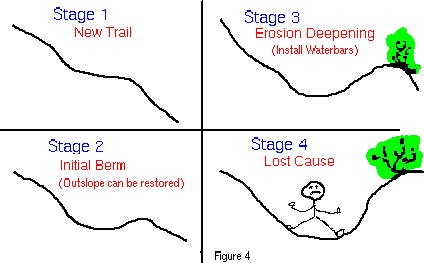
The outslope is maintained at Stage 2 by simply pulling the small 4" - 5" berm back into the trail tread. This unglamorous work must be performed again and again by trail crews, but in many cases, it the outslope is restored on a regular basis, little or no maintenance is needed of any other kind. However, some use patterns (extensive equestrian use), soil conditions (sandy) and climate conditions (high precipitation) combine to minimize the effectiveness of this maintenance tool; it just has to be done too often to make it worthwhile.
Once
a trail has reached Stage 3, the berm is too large and overgrown with
vegetation to be removed; the outslope cannot be restored and other maintenance
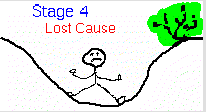
approaches must be employed. When a trail deteriorates to Stage 4, the trail is
a lost cause, and the best solution is trail abandonment and relocation.
Install
and Maintain Water Bars
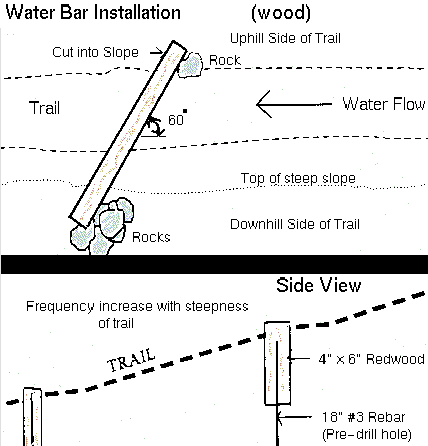
Water bars divert water off a trail at controlled points along the trail. They can be incorporated in the original construction of a trail, or they can be installed later as a maintenance measure. Done well, a series of water bars can effectively eliminate erosion and stabilize a trail for years. Done poorly, water bars can accentuate trail erosion and become dangerous tripping hazards.
The
most permanent water bars are made from native rock obtained on-site. When rock
of a suitable size is not available, water bars can be made from 4 x 6 redwood
timber, or native logs. Peeler logs or other landscaping products should not be
used because their appearance is foreign to a natural environment. Bicyclists
prefer a new product made of black rubber that diverts water, but is flexible
enough to allow cyclists to easily cross. However, this too, may be
inappropriate for a natural environment.
There
are many options about the proper installation of water bars. Three trail
handbooks will promote three different approaches. Well, here is one more. The
elements of a properly installed water bar are:
- Set the water bar at a 60 degree angle across the trail. A water bar set perpendicular (90 degrees) across the trail will not divert the water off. A water bar set 30 degrees across the trail can be awkward to hike or ride over.
- Extend the water bar such that water is carried completely off the trail to a steep side slope. Otherwise, the water flow will bypass the water bar and erosion will occur.
- Provide rock at the downslope end of the water bar to dissipate the energy of the flowing water, thereby minimizing erosion.
- The top of the water bar should be nearly flush with the trail tread to minimize tripping hazards. On first consideration, it may not make sense to make the top of the bar flush with the tread because there would be nothing to "catch" and divert the water. However, we are not concerned about diverting all water flowing down a trail, only that amount of water than causes erosion. With the bar flush, its effectiveness only kicks in when there is enough water to erode away a lip on the uphill side of the water bar, which then allows the bar to divert the water flow.
- The boulders used for rock water bars must be huge, otherwise, they will be kicked out of place by a horse. The rocks should overlap like shingles on a roof to prevent water from flowing between rocks and eroding away the integrity of the water bar. In addition, long boulders with one flat side work best to prevent tripping hazards.
Water bars need regular maintenance. The excess soil and debris that build up at the downslope end of the water bar needs to be periodically graded out to assure that water flows off the trail. Without regular unplugging, a water bar is useless.
Maintaining Drainage Dips
A drainage dip is built into the original trail alignment and is a change in gradient (a "dip" in the trail) that dissipates and diverts water flow (it's like a built-in water bar). Like a water bar, it only remains an effective means of erosion prevention as long as regular maintenance keeps it unplugged.
Pruning
Pruning vegetation is an essential and regular part of trail maintenance, especially in brushy chaparral areas. Multi-use trails should have 10' vertical and 8' horizontal clearance (though there will be exceptions for the sake of protecting a tree or skirting around a large boulder).
Too
often, trail pruning is accomplished in the most expeditious manner possible --
a branch intrudes within the walking/riding space of the trail and is quickly
lopped-off so that it doesn't intrude and the debris is indescriminantly tossed
aside. However, our goal in trail maintenance is to maintain a trail in as natural appearance as possible. A quick
pruning job deals only with the function of trail maintenance, not the
aesthetics.
There
are 6 elements of acceptable pruning in the State Park System. Each of these
elements makes pruning a more tedious maintenance task, but results with a
trail that is compatible with the natural environment.
- Do not toss debris! Branches that are randomly discarded usually end up hanging in adjacent shrubs or trees. These dead branches are both unsightly and create a fire hazard.
- Place debris out of view. This element requires the extra effort of dragging branches under and around shrubs.
- Place the butt (cut) end away from the trail. This will help disguise the debris.
- Each cut branch should be touching the ground to promote decomposition. This means that brush piles are not appropriate.
- Pruning should be done sensitively so that the trail appears natural and not as if a chain saw just blasted through. Trail users should not be aware that any maintenance work has recently been done.
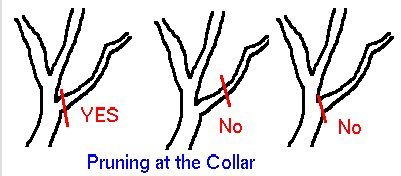
- Prune to the collar of any branch stem for the health of the shrub and a more natural looking result. At the base of any branch there is a wide section that contains a plant's natural healing agents. Any pruning performed away from this collar will expose the plant to a greater risk of infection. A cut at the collar will naturally heal. For large branches over 2" in diameter, cut from the bottom, then cut down from the top. This prevents tearing of the bark, reducing infection.
Signing / Mapping
Adequate signing and mapping keeps trail users on the trail. Uncertainty about which trail is which will lead to new trails being created by trail users. These new trails will become maintenance headaches and will ultimately need to be abolished.
Check Dams
Check dams are a popular, though generally ineffective, instrument of trail maintenance. A wood timber is placed 90 degrees across a trail. In theory, the check dam is intended to slow the velocity of water flowing down the trail, thereby reducing erosion. In reality, nearly all check dams only halt erosion in the 2 to 3 feet immediately behind the check dam, but accelerate erosion immediately below and beside the dam. This is because they never take the water off the trail, they only slow it down momentarily. For check dams to be truly useful in stopping erosion, they need to be spaced 3 feet apart, and this effectively makes a stairway out of the trail.
Check
dams should not be used in trail maintenance. However, they may have limited
application in restoring abandoned trail alignments to natural conditions.
Import Fill Material
A deeply trenched trail can be restored by importing dirt or decomposed granite, compacting it, and recreating a well-drained outsloped trail. However, in most situations, this approach is usually both cost prohibitive and far too labor intensive.
TRAIL REROUTING
Trail rerouting is beyond the responsibilities of a trail maintenance crew. New trail alignments must be flagged by experienced park staff and then reviewed by resource specialists for compliance with the California Environmental Quality Act. Trail maintenance crews can provide valuable assistance by alerting park staff to those trail routes that may need to be rerouted.
There
are two measurements that dictate that a trail relocation is needed:
- When the maintenance crew is dealing with a poorly designed trail that has deteriorated to the extent that remedial measures will not work or will constantly need repair or replacement, AND
- A significantly better route is available.
The telltale signs of a trail that needs to be relocated are: deep trenching
and a gradient exceeding 20% over about 100 feet of trail.
REFERENCE MATERIAL
This document represents a cursory look at the basic aspects of trail maintenance and only briefly touches on trail construction techniques. There are many valuable references that dive into much greater detail; a few are listed below. Each of them can be obtained by contacting the sponsoring agency.
NPS TRAILS MANAGEMENT
HANDBOOK, United States
Department of the Interior, National Park Service, Denver Service Center, 1983
(A small, but comprehensive, pocket manual on trails construction and
maintenance.)
Trails Coordinator, National Parks
Service
P.O. Box 25287, 655 Parfet Street, Denver, CO 80255
A TRAIL MANUAL, East Bay Regional Park District,
Oakland CA. 1976
GUIDE FOR MOUNTAIN TRAIL
DEVELOPMENT, United
States Department of Agriculture, Forest Service, 1984
Forest Service - USDA
Engineering Staff - Washington Office, Attn: Publications Specialist
P.O. Box 2417, Washington, D.C. 20013
(703) 235-8198
TRAIL DESIGN, CONSTRUCTION,
AND MAINTENANCE,
Appalachian Trail Conference, Harper's Ferry, 1981
Appalachian Trail Conference
P.O. Box 236, Harpers Ferry, WV 25425
(304) 535-6331
TRAILS MANUAL, Charles Vogel, 1968
Equestrian Trails, Inc.
10723 Riverside Drive, North Hollywood, CA