Poughkeepsie
Polluters:
Brownfields Past and
Present
Brownfields are increasingly seen as a
potential asset for urban revitalization.
This paper is intended to be a first resource for anyone interested in
becoming involved in brownfield redevelopment in Poughkeepsie; we discuss
legislation affecting potential involvement, common contaminants and methods of
remediation, strategies for ensuring equity in redevelopment, and some
historical and geological information about conditions specific to Poughkeepsie
that are relevant for brownfield reclamation efforts.
Carolina
Lukac
Katie
Phillips
Siobhan
Watson
Introduction
Brownfields are increasingly seen as a potential asset for urban revitalization. This paper is intended to be a first resource for anyone interested in becoming involved in brownfield redevelopment in Poughkeepsie; we discuss legislation affecting potential involvement, common contaminants and methods of remediation, strategies for ensuring equity in redevelopment, and some historical and geological information about conditions specific to Poughkeepsie that are relevant for brownfield reclamation efforts. Across the United States, a variety of brownfield remediation projects have been started in the past two decades, motivated by the desire for more compact urban areas and the revitalization of city centers. As attention to brownfields has increased, legislation has rapidly evolved to encourage clean up and redevelopment. Site investigation and remediation technology have improved and community members have become more involved in the redevelopment process. With several changes to legislation, incentives, and technology, in addition to many interested parties, information about brownfields can be difficult to gather and dialogue between the participants can be easily stalled. We hope this paper will contribute to the development of an accessible source of information about local brownfield issues.
Poughkeepsie’s Brownfields
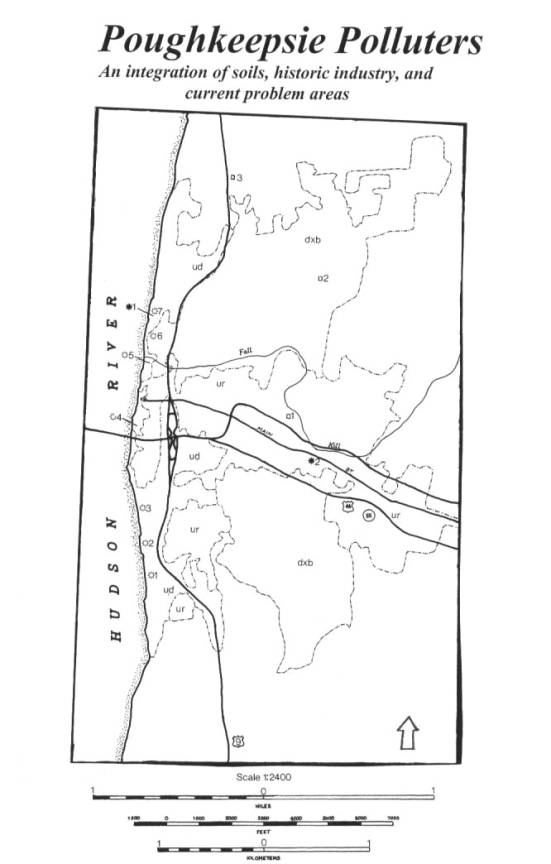
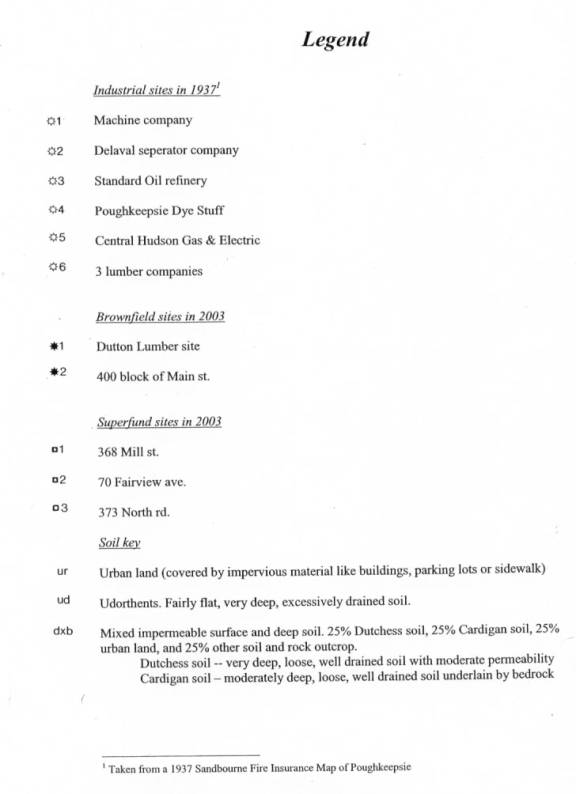
The difficulty in finding information about owners and development plans for possibly contaminated sites made our search for information on Poughkeepsie’s brownfields frustrating. The limited information we found about current brownfields demonstrates the need for a better resource base. Regardless, we now know that the Dutton Lumber site (located on the waterfront just north of Central Hudson) and the 400 block of Main Street are currently identified on the remediation process, as are three Superfund sites (Figure 1). Historical information about Poughkeepsie provided insight into places that may be considered brownfields in the future. We were able to identify past industrial use by studying historic Sanborn Fire Insurance Maps (1937), which show what industries have previously existed within the city of Poughkeepsie. The vast majority of industry was located directly on the waterfront (Figure 1). The main industries we identified were: lumber, metal, coal, oil refineries, and machinery and utility sites. Since coal, machinery manufacturing, and primary metal industry are all sites associated with chlorinated hydrocarbon pollution, the utility and industrial sites most likely caused some heavy metal contamination to the waterfront and the oil refineries probably left behind some petroleum hydrocarbons. Much of this noxious material must have run directly into the Hudson River. Some of these pollutants might possibly still be there. Considering that in the late 19th and early 20th centuries there were no Superfund laws or stringent cleanup regulations, the pollution may still be around even though some of those industries are long gone. Although it is hard to know which sites may be polluted, this historical
information helps us predict the consequences of industrial land use.
|
Table 1. Top pollutants
currently being released in Poughkeepsie |
|
1) nitrate compounds 2) toulene 3) xylene (mixed isomers) 4) N-methyl-2-pyrrolidone 5) NH3 6) HF 7) methyl isobutyl 8) methyl ethyl ketone 9) HCl 10) H2SO4 11) HNO3 12) methanol 13) ethylbenzene 14) Zn 15) Pb compounds |
Current polluters
In addition to historical information, it is important to
think about current polluters, as those sites may someday become
brownfields. In Poughkeepsie, IBM releases 656,802 lbs. of toxic chemical releases a year,
Chemprene Inc. (a rubber band and miscelaneous. plastic manufacturing company)
releases 38,867 lbs. a year, and Great
Eastern Color and Lithographic Corp. (a printing and publishing company)
releases 8,160 lbs. a year. The major
pollutants being released in Poughkeepsie are known (Table 1), and keeping that
information accessible will help future brownfield reclamation efforts.
Brownfields defined
The EPA defines brownfields as
“abandoned, idled, or under-utilized industrial and commercial facilities where
expansion or redevelopment is complicated by real or perceived contamination”
(EPA, February 2003). This broad
definition allows many types of properties to be called brownfields and does
not make the term an official land use category. Former industrial sites are frequently identified as brownfields,
as are abandoned properties that have accumulated a lot of potentially
hazardous waste. Contamination in
brownfields can be visible (e.g., broken glass, metal scraps, pipes), or
invisible (e.g., arsenic, lead, etc. in soil and groundwater), and can have any
degree of severity. The EPA estimates
that 500,000 to a million brownfields exist in need of remediation in the
United States, most of them in urban areas (Concrete Products, 2002). Properties are most often identified as
brownfields when land changes hands, when someone expresses a public health or
environmental concern, and/or when a developer or local government wants to use
the available space.
Smart
growth policy
The interest in redeveloping
brownfields has political, environmental, and socioeconomic motives. Above all, redevelopment is a key objective
in the national push towards the revitalization of urban areas. Brownfield redevelopment can play an
important role in efforts to reverse problems such as suburban sprawl, farmland
loss, limited job and business opportunities in inner cities, and a lack of
urban recreational space. The benefits
of brownfield redevelopment are often underestimated in comparison with the
cost of greenfield development.
According to a report by George Washington University, every
acre of reclaimed brownfield saves 4.5 acres of greenspace (EPA, 2003a).
Brownfields often represent the only land available to redevelop within
city limits and therefore provides a potential supply of land for commercial,
industrial, and housing demands. Eyesores such as dilapidated factories
and vacant lots used as dumping grounds can be turned into job and tax creating
activities. Contaminated sites also pose
a threat to the environment and public health.
The cleanup and redevelopment of brownfields promotes infill over
sprawl, can improve environmental and health conditions in cities, and can have
positive impacts on struggling city economies. Since Dutchess County relies heavily on its
scenic tourist economy, Poughkeepsie might benefit from adopting smart growth
policies to reuse abandoned city sites in order to preserve its open space
resources.
Superfund sites and brownfields
Similarities between Superfund sites and
brownfields can lead to confusion of the two terms. The 1980 Comprehensive
Environmental Responses, Compensation, and Liability Act (CERCLA) is
referred to as “Superfund” and aims to identify responsible parties and require
them to bear the costs of contamination (EPA, 2003b). The cleanup of Superfund sites is driven by outrage over serious
contamination and Superfund policy mandates strict cleanup standards following
well-defined guidelines for the remediation process (Wernstedt, 2001). The program has been accused of being
inflexible and ignoring site-specific needs, but this inflexibility provides a
commitment to rigorous cleanup standards that brownfield remediation does not
always promise. On the other hand, brownfield cleanup programs are
carried out mostly by economic and social concerns over less severely
contaminated sites. Brownfields are mostly dealt with at a local rather
than federal level, and there is much greater flexibility in how remediation is
dealt with. In the past, Superfund laws
directly applied to brownfield sites although recently there have been some
policy amendments to ease the litigation involved in clean up and
redevelopment. However, money is often
lacking for cleanup since the EPA only funds brownfield pilot programs. Poughkeepsie’s difficulty in finding
investors for brownfields projects can be seen in its pending sale of the
Delaval Separator Company property to a private developer for only $1 (C. Woodhead,
pers. comm., 2003).
Liability,
Voluntary Action Programs, and incentives
In
response to reoccurring dialogues on health and environmental concerns, smart
growth policies, and city revitalization projects, the federal government has
created new legislation to encourage and facilitate brownfield
remediation. Acknowledging the market
potential and the environmental and social opportunities invested in cleanup
and redevelopment has been crucial to more comprehensive and effective
brownfield legislation. Above all, the
initiatives have been aimed at reducing the liability concern for individuals
or parties potentially responsible for contamination and increasing the support
for alternative programs and funding.
Together
with the EPA, the current administration has expanded the scope of brownfield
initiatives from the early days of 1995 when the first brownfield redevelopment
program was introduced (Ackerman, 2001).
Most recently in 2002, President Bush signed The Small Business Liability Relief and Brownfields Revitalization Act
in what was called “a great event for the environment in America” by the EPA
Administrator Christine Todd Whitman (Concrete Products, 2002). The
proposed goals are optimistic: to remove environmental hazards from
communities, to relieve pressure to develop open space, and to revitalize
communities by creating jobs and tax rolls. In addition to doubling the
funds for state and local programs available through the EPA to $200 million,
the bill grants liability protection for past, current, and future landowners
and prospective purchasers by relieving the liability constraints of federal
Superfund laws (EPA, 2003c).
The
legislation addresses liability as an important deterrent to brownfield
redevelopment. Indeed, the main
obstacle to redevelopment has been a liability concern for innocent landowners
and potential developers, even if they were not responsible for the
contamination. In part because of the strictness of Superfund’s
assignment of responsibility to all current and former owners of contaminated
sites, the threat of liability and unforeseen costs has hindered a confidence
and willingness to engage in brownfield redevelopment. Policy amendments are often based on the
belief that reducing liability burdens will instill more confidence to
participate in potential redevelopment projects if financial incentives offset
environmental liabilities.
Nevertheless, the long term success of this program will depend on how
effectively liability is redirected.
Furthermore,
brownfield legislation has sought to encourage innovative cleanup programs as a
way of bridging the gap between the role of the federal government and state
authorities, local governments, and individuals interested in
redevelopment. The EPA manages State Voluntary Action Programs to allow
private parties or volunteers to initiate the identification and cleanup of
sites. Voluntary participants can avoid
the lengthy administrative procedures usually encountered in site assessment
and remediation. Protection from liability and future federal and state
enforcement actions comes through “no further action” letters, whereby the EPA
promises not to become involved if certain guidelines are followed (EPA,
2003d). Besides being a huge incentive against extensive litigation,
voluntary programs aim at increasing community involvement in brownfield
programs by allowing residents to play an active role in assuring that
remediation and redevelopment respond to wider community goals. Neighbors may have more of a say as to whether
a playground, community center, housing project, or industrial factory is
redeveloped on the site. Since
community members tend to be the most concerned with environmental and health
threats, the ability to oversee and mediate cleanup and redevelopment projects
is to their benefit. In addition,
voluntary programs cut short the delay in relying on the federal government to
take action and reduce developers’ reluctance to buy properties. Such alternative programs have made possible
numerous redevelopment projects in 44 states and have been successful in
increasing active participation in brownfield cleanup and redevelopment.
Legislation
has also encouraged the creation of partnerships to facilitate mutual goals and
support investment. Since brownfields play a role in public health,
environmental protection, transportation, economic development, and community
revitalization, the support of these groups is essential for the successful
management of brownfields programs. One example is the opportunity for
adoption of remediation into other community projects. Such is the case with the EPA’s “Green
Buildings on Brownfields” program and its partnership with Habitat for Humanity
to build energy efficient houses on former contaminated sites (Ryan, 2002).
Incorporating brownfields into greenway plans is another way of building
partnerships among groups with similar agendas. For example, the planners of the Woonasquatucket River
Greenway Project in Providence, RI were able to incorporate severely
contaminated brownfields into the greenway’s route (Braswell, 1999). The
project became a Brownfields Showcase Communities project, with EPA funding to
go with it. The remediation has brought
an ecological focus to the greenway project, and has allowed the plans to attract
much more support. National and local
attention has been brought to the project, and neighbors have been delighted to
support the greenway. This
type of cooperation can benefit all parties, and legislation has sought to
maximize it. Encouraging cooperation
with environmental and community organizations in Poughkeepsie has the
potential to speed brownfields redevelopment and increase satisfaction with the
results. Strong non-profit
organizations and a variety of planners of city greenways make up a large
sector of involved citizens who could become more interested in brownfields
reclamation if the connection to their goals were clearer. Scenic Hudson’s possible involvement with
the purchase of the Dutton Lumber site is a local example of different parties
and interests coming together to remediate a brownfield site and link up with
the greenway plan.
Site assessment & remediation
One of the main concerns of developers is
how to maximize site value while minimizing cleanup cost. The sites that have
the greatest potential for profit, and therefore are the most desirable to
developers, include sites near a waterfront, commercial, or business district,
and sites that are easily accessible by public transportation or by major
roads. Governments and developers are
generally more reluctant to clean up other sites. Sites that are seen as low priority to governments and developers
include smaller, less accessible brownfields in deteriorated
neighborhoods. Location and
marketability determine the development priority of sites when the redevelopment
is motivated by profit-generation. It
is not surprising that recently completed brownfield remediations in
Poughkeepsie are all found either along the waterfront or on Main Street.
Once a government or developer has
focused on a site to work on, the process can begin. However, the initial assessment of a site can take a long time
and cause the project to stagnate.
Before remediation can start, the government or the developers must
assess the extent of the pollution and how far it has spread. One of the main ways that pollution can
spread from a brownfield into surrounding areas is by way of groundwater. If the soil in the brownfield is very
permeable (i.e. sand or gravel) and the aquifer is unconfined (meaning there is
no thick layer of bedrock keeping it from connecting with overlying soil),
there is a good chance that pollutants in the soil have reached the
groundwater. However, there may not be
any groundwater underneath that particular site. The vulnerability of the groundwater must be assessed by
combining data from a surface geology map with data from an aquifer map
(Appendix 1). Vulnerable groundwater
makes remediation difficult and always makes the cost of cleanup high.
Even with no significant groundwater
vulnerability, other problems can make remediation costly. The former use of a site determines what
contaminants are present, so looking at the historical use can help with the
assessment. There are four classes of
common contamination: heavy metals, chlorinated hydrocarbons, petroleum
hydrocarbons, and PCB’s. Heavy metal
contamination is commonly found at former industrial, utility, and
manufacturing sites. The sites of
several 1937 lumber companies on Poughkeepsie’s waterfront may have this type
of contamination. Chlorinated hydrocarbons
are often detected at sites previously used for the coal industry, primary
metal industry, and manufacturing of industrial machinery or equipment. A machine company that existed in 1937
(Figure 1) could have released chlorinated hydrocarbons in Poughkeepsie that
may still be there. Petroleum
hydrocarbons are found mostly in old chemical and petrochemical sites. They are
also common in industries involved in the manufacturing of rubber, and
miscellaneous plastic products. The
Standard Oil refinery and Central Hudson Gas & Electric sites (Figure 1)
probably left these behind. PCB’s are
not linked to any one type of site, but statistically they are more likely to
be found in sites owned by the government (Stiber et al, 1998). Associations between industries and the
pollutants released allow chemical testers to make informed guesses about
contamination and use the most appropriate testing method (Appendix 2).
The traditional method of testing, which
is still advocated by the EPA, is extremely time consuming and costly. It involves taking large soil and water
samples through the drilling of trenches or wells. Once the samples are extracted, they are sent to a lab where comprehensive
tests are performed. The results of these tests could take up to two months and
cost thousands of dollars. If the test results are somehow inconclusive (the
type of pollutants expected were not present in significant amounts), or if
more samples are needed, a return investigation is often necessary. This alone could cost from $20,000 to
$500,000 (Munro et al, 2000). A number
of new, portable technologies are available to make initial testing less time
consuming and expensive (Appendix 2). These
methods can be more quickly done on site and can test for many things at once
without the huge costs of lab work.
Unfortunately, though, only 6% of EPA funded brownfields projects are
using these methods (Munro et al, 2000).
The EPA continues to recommend the traditional testing method,
preferring to rely on what has worked in the past rather than risking working
with new technology. Also, information about new technologies is not easily
available to community members, municipalities, and others involved in
brownfield redevelopment, so informed choices about which methods to use are
hard to make. The continued use of
costly, inefficient methods adds to brownfield redevelopment barriers.
Once the type and location of the
contamination has been assessed, remediation options can be discussed. The
remediation method used depends primarily on the type and extent of
contamination - mainly whether or not it has reached any groundwater. The high cost of remediation is another
barrier to redevelopment, but in some cases, unnecessarily stringent clean up
standards are used. The clean up should
not only reflect the risk of the site, but also its intended future use. For example, a site that has not
contaminated any groundwater and is intended for future industrial use does not
need to be cleaned up as thoroughly as a site that is going to be used as a
playground. If the contaminants will
not harm people, wildlife, or groundwater, they don’t need to be cleaned up
quite as carefully. Noxious chemicals
have to be cleaned up whatever the future land use, because even if people
around it aren’t affected, vegetation might be. Heavy metals, specifically Cd, Cu, Ni, Pb, and Zn, although once
thought to be harmful to plants, were found not to have any significant affect
on vegetation or soil processes even with relatively high levels of metals. A site contaminated with heavy metals that is
going to be used for industrial purposes and that poses no significant risk to
groundwater needs barely any remediation, and will not cost much to redevelop
(Murray and Henderson, 2000). This is
an area where the flexibility given to municipalities in determining cleanup
standards can save money without risking public health.
Environmental Justice & Community Involvement
Legislation and incentives designed
to stimulate brownfields reclamation have been advertised primarily in terms of
their economic potential. For the
public, the generation of jobs and taxes is the attraction; for developers and
investors it is profit. While finding
ways to lower barriers to brownfields redevelopment is a good goal for cities
with unused space, some authors have questioned the ability of programs that
are driven by economic considerations to maintain a commitment to the
neighborhoods in which the sites are found (McCarthy, 2002; Kibel, 1998;
Davies, 1999). Concerns about justice
in making and carrying out brownfields redevelopment plans seem to appear
frequently in brownfields literature, so it is important to consider how equity
can be promoted.
The Environmental Justice movement
seeks to create equal access to environmental resources and equal protection
from ecological hazards for all communities.
It is a movement that gained political prominence at around the same
time as brownfield redevelopment programs did and the Clinton administration
was very interested in presenting the two as compatible (Kibel, 1998). A series of public discussions called
“Public Dialogues on Urban Revitalization and Brownfields: Envisioning Healthy
and Sustainable Communities” was held in five cities to try to gauge public
response to brownfields initiatives and to incorporate the desires of community
members into the development of legislation.
Incorporating the wishes of many participants proved to be difficult,
but the desires that were revealed most clearly in those discussions were that
brownfields plans improve the public health and economic well being of the
surrounding community.
In contrast to the strictly held
cleanup standards of Superfund sites, brownfield remediation standards are left
to local governments to enforce, allowing flexibility in planning but also
leaving the possibility for dissatisfaction with varying degrees of remediation
(Davies, 1999). Voluntary cleanup
programs and liability waivers can reassure investors and developers that a
project is worth their time, but these programs have also been accused of
allowing oversights in cleanup efforts and overprotecting those at fault. Lower remediation standards may seem to be
the only option to a town having difficulty convincing anyone to invest in an
undesirable property. It is important,
therefore, for a municipality that is dealing with brownfields to develop
standards that can be applied to all sites.
Creating standards on a case-by-case basis leaves too much potential for
injustice to lower-income communities.
The difficult balance between leaving enough flexibility to encourage
interest in brownfields while maintaining enough strictness to ensure the fair
application of cleanup levels.
The allocation of funding to
brownfields is an area where the potential for real and perceived injustice is
great. Through the EPA’s Pilot Program,
municipalities are encouraged to choose demonstration sites that will stimulate
private interest in brownfields by showing the benefits of a successful
reclamation (McCarthy, 2002). Funding
is provided for the demonstration site, but not for projects beyond that, so
the choice of site plays a large part in determining whether the Pilot Program
will work. The goal of creating large
amounts of interest in brownfields is a good one, but this program has the
potential to use public funding for properties that may have been economically
viable without help, leaving less desirable properties without the public
funding they need. In choosing the
sites of brownfields demonstration projects, municipalities should ensure that
the project has a good chance of success in generating interest, but they
should also be careful not to fund properties that don’t need assistance.
The potential for economic injustice
continues after the allocation of funding is resolved; the use of the
revitalized brownfield can be quite controversial. Jobs may be generated at former brownfields, but there is no
guarantee that jobs will go to area residents, and the use of a site to most
benefit people from outside the neighborhood can create resentment. Some cities have tried to encourage
satisfaction with the use of brownfields by creating tax incentives for loans
made to local small businesses (Kibel, 1999).
Others have favored projects with tangible health and economic benefits
for the community in which it takes place.
Brownfields neighbors respond to
proposed projects with enthusiasm as well as concerns. The benefits to the neighborhood can be very
attractive, and many neighbors are eager to see unused land go to good
use. The crucial factor in whether or
not neighbors will be satisfied with a brownfields project is the degree to
which they are involved (Davies, 1999).
The involvement of community members can also make the process of
remediation faster and more effective – a study of EPA pilot projects concluded
that community involvement is not only fair, it is “a mechanism for faster,
better cleanup and redevelopment” (Davies, 1999). Neighbors have access to useful, site-specific knowledge that can
be tapped into with meaningful involvement.
Municipalities and developers may have trouble finding routes for local
involvement, but both can take steps to encourage it. Municipalities can work with existing neighborhood groups during
the selection of a developer to ensure that the project will be desirable, and
can conduct polls prior to deciding on a project. During the development process, planners can be required to
create easy-to-read materials and make them widely available to neighbors
(Zarcadoolas, 2001).
Access to information via GIS
Information about brownfields is often difficult to access,
both for interested neighbors and for developers and investors who might be
interested in brownfields. In response
to the scattered information available, some authors have suggested gathering
information in a GIS-based decision support system that would be available for
many interested parties to use (Thomas, 2002).
The city of Emeryville, CA has done this; an online GIS system has been
created that allows anyone to look at city maps and get information about
things like the owner, value, and current land use of a give property (Appendix
3). This new way of keeping a variety
of parties informed may become very useful in solving some of the difficulties
associated with redevelopment.
Conclusion
Brownfields can pose economic,
health, and social problems, but they can also be considered resources that can
create new spaces in crowded cities and generate economic activity on
previously abandoned land. The way a municipality goes about the process of
reclamation can make all the difference between successes and failures. Hopefully, more cities will make centralized
information available to those interested in brownfields, and will make better,
more informed decisions about how to redevelop, and planners will continue to
become more interested in reclaiming brownfields.
Works Cited
Ackerman,
J. 2001. Finding your brownfield of dreams. Waste Age 32:166-73.
Braswell,
B.J. 1999. Brownfields and bikeways: making a clean start. Public Roads
62:32-40.
______. Concrete Products. 2002.
Brownfield legislation spurs ‘green’ business.
Concrete
Products. 105: PC6-PC8.
Davies,
L.L. 1999. Working toward a common goal?
Three case studies of brownfields
redevelopment
in environmental justice communities.
Stanford Environmental
Law
Journal 18:285-329.
Environmental
Protection Agency. 2003a. Brownfields Cleanup and
Redevelopment.
<http://www.epa.gov/swerosps/bf/htm>
accessed April 2003.
Environmental
Protection Agency. 2003b. Glossary of Terms.
<http://www.epa.gov/swerosps/bf/glossary.htm#brow>
accessed February 2003.
Environmental
Protection Agency. 2003c. Small
Business Liability Relief and
Brownfields
Revitalization Act.
<http://www.epa.gov/swerosps/bf/sblrbra.htm>
accessed March 2003.
Environmental
Protection Agency. 2003d. State Voluntary Cleanup Program
Guidance
History.
<http://www.epa.gov/swerosps/or.vap_hist.htm>
accessed April 2003.
Greenberg, M. et
al. 2001. Brownfield redevelopment as a smart growth option in the
United
States. The Environmentalist
21:129-143.
Kibel, P.S. 1998.
The urban nexus: open space, brownfields, and justice. Boston
College
Environmental Affairs Law Review 25:589-618.
McCarthy,
L. 2002. The brownfield dual land-use policy challenge: reducing barriers
to
private
redevelopment while connecting reuse to broader community goals. Land
Use
Policy 19:287-296.
Munro, J. F.,
and K. A. Tzoumis. 2000. Conquering the brownfields frontier through
the
enhanced
deployment of environmental assessment technologies. Public Works
&
Management Policy 4:213-221.
Ryan, D. 2002.
EPA Administrator announces brownfields program partnership with
Habitat
for Humanity International. Environmental
News, Environmental
Protection
Agency.
<http://www.epa.gov/swerosps/bf/html_doc/pr021302.htm>
Stiber, N. A.,
M. J. Small, and P. S. Fischbeck.
1998. The Relationship between
historic
site
use and environmental contamination. Journal
of the Air & Waste
Management
Association 48:809-818.
Thomas, M.R.
2002. A GIS-based decision support
system for brownfield
redevelopment. Landscape and Urban Planning 58:7-23.
Wernstedt,
K. 2001. Devolving Superfund to Main st. – avenues for local community
involvement. Journal of the American Planning
Association, 67:293-313.
Zarcadoolas,
C. 2001. Brownfields: a case study in partnering with residents to develop
an
easy-to-read print guide. Environmental
Health 64:15-20.
Figure 1.
Brownfields, Soils and Historic Industrial Land Uses